
Operational Excellence Through Incremental Suffering: Bureaucracy-by-design
The Parable of the Museum of Slightly Crooked Pictures

A few days ago, I saw my friend Carey Lening from Privacat re-post the following excerpt from Adam Mastroianni’s “Thank you for being annoying”:
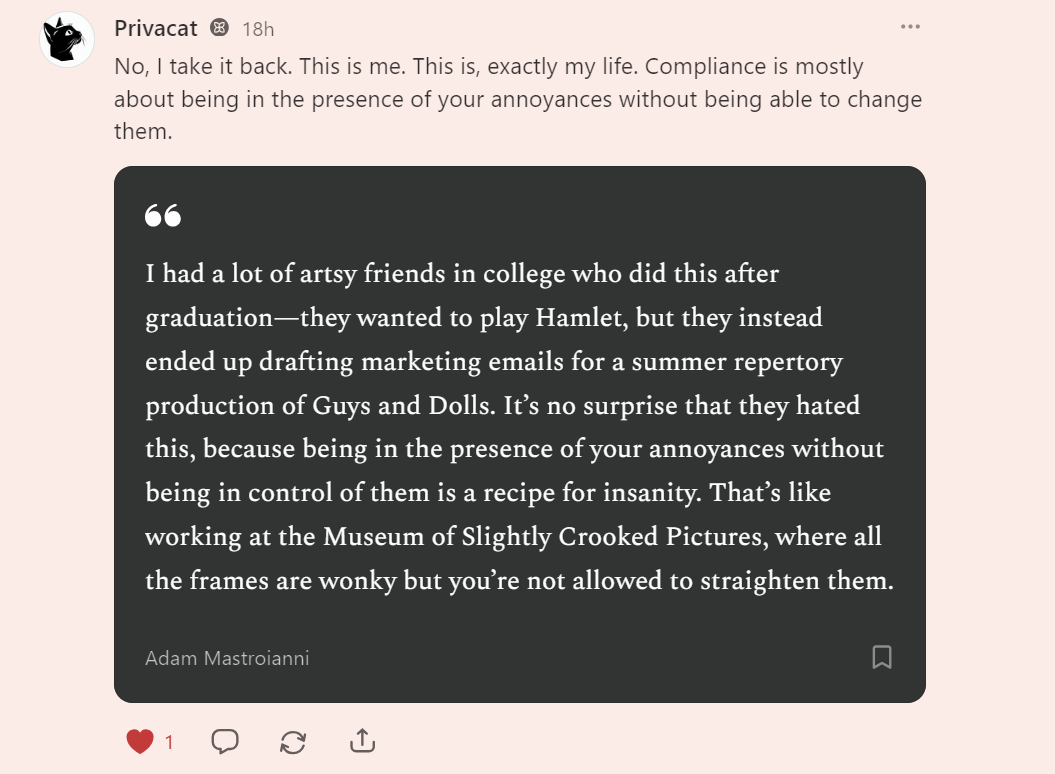
Those who work in compliance-adjacent fields may agree on how funny and sadly relatable this actually is.
But this misses an even more maddening nuance: having permission to change your annoyances may not be the key to less insanity after all.
This article may be among the least dogmatic (or formal) I’ve written so far. But, if you value pragmatism and humor and you work in corporate compliance or any other admin role… stay with me.
Today, I introduce:
The Parable of the Museum of Slightly Crooked Pictures
Imagine that, one day, a more business-saavy gallery owner takes over the management at the Museum of Slightly Crooked Pictures. They finally look at the many complaints from visitors saying that the crookedness is annoying to the eye and it affects their decision (not) to buy. So, they finally give you permission to straighten them!
But, there’s a caveat: The pictures have been on this exact same angle for so long that, when slightly tilted to the center, the frames get decoloured. There’s also the fact that the wall behind the frames gets scratched when this happens, requiring a slight layer of paint that only covers the 2 damaged centimeters.
There are over 7,000 displayed pictures. The entire Museum’s revenue depends on daily visits by tourists to that exhibition, even if no one decides to ultimately buy anything.
The obvious solution? Shut down. Take all the Pictures off (with care). Repair all minor discoloration in the frames, or just replace them if more practicable. Repaint all the walls. Place the restored frames back on. Reopen the Gallery.
If only it were so simple! The new management anounces that, unfortunately, the disruption to the service would cost more loses (due to people not being able to visit) than the expected sales after all the modifications. However, they still want to perform the necessary changes to “create a better experience for clients and bump up that visit-to-sale ratio”.
The chosen solution? To have you (1) manually straighten each one of the 7,000 pictures, (2) carefully paint over the scratched 2 centimeters of the wall behind it, and (3) apply a coat of varnish to each frame. All of this, while keeping the exhibitions open for visitors.
This way, the pictures gets straightened— albeit, at a glaciar pace— and process continuity is maintained.
C’mon, how is this not a win-win!?
Why Simplification is not so simple
Apparently, there are a few formal concepts in organisational theory to describe this phenomenom:
Gammon’s Law of “bureaucratic displacement”
Gammon’s Law (also called the “theory of bureaucratic displacement”) is the claim that in a bureaucratic system, increasing input (expenditure, resources, staff, rules) is often accompanied by falling or stagnating output. In other words, useful work is displaced by non-productive bureaucratic activity.
Dr Max Gammon formulated this idea in studies of the British National Health Service, observing that as hospitals and bureaucracy grew, measures of output (e.g. patients discharged) declined.
He goes as far as to affirm (about bureaucratic systems) that they act ”like ‘black holes’ in the economic universe, simultaneously sucking in resources, and shrinking in terms of ’emitted’ production”.
In this article by the Australian Doctors Federation, he provides a painfully realistic exmple:
”Walking along a wide corridor in a London Teaching Hospital with which I was unfamiliar I asked a person in nursing uniform the way to a certain ward. “Oh, I don’t know where the wards are, I am in administration” she replied as though I had insulted her. She turned and walked through some glazed doors which opened on to what had been a long Nightingale ward. It was now divided into a multitude of open-plan offices. Meanwhile in the A&E Department on the floor below patients were lying on trolleys for up to 48 hours and others were having their operations postponed owing to shortage of beds.”
While many would share the sentiment, I do think that Gammon’s Law isn’t perfect. Misallocation of resources can be influenced by financial incentives that are not 100% tied to a clean, bureaucratic increase in input: for example, admin jobs may be created due to reception of public funds in exchange of creating those specific roles, different income streams determining different budgets for the taskfoce, or simply poor resource management.
In the previous example of the (now infamous) Museum of slightly crooked pictures, what causes the displacement is the methodology chosen by the new management to get the pictures straightened. So, what causes bureaucratic displacement?
The red tape paradox
The red tape paradox is the idea that efforts to cut bureaucracy often end up producing more of it: Attempts at reform tend to generate new rules without eliminating old ones, leaving organisations with an even heavier compliance burden.
This concept was introduced by Barry Bozeman, one of the leading scholars of public administration, whose research has been very influential in organisation theory applied to the operations of public administrations.
Bozeman distinguishes between formalisation, the neutral presence of rules and procedures as necessary baselines for operational continuity, and red tape, rules that impose burdens without serving any legitimate purpose.
But, how do you know when rules are necessary for formalisation vs when they are just red tape?
For this, Bozeman introduced the concept of rule density, the share of organisational resources devoted to compliance, and the stringent efficacy criterion: a rule only qualifies as ‘red tape’ if it creates burdens and completely fails to achieve its intended purpose. But rules whose contribution is less than their compliance burden might also constitute red tape.
As Bozeman originally put it, organizational red tape means “rules, regulations, and procedures that remain in force and entail a compliance burden for the organization but have no efficacy for the rules’ functional object.”
For him, the key lies in a “balanced model”: accounting for the inevitable trade-offs mong efficiency, accountability, and fairness, and smartly allocating resources to the type of bureaucracy that, while appearing budersome, serves crucial purposes and legitimally benefits stakeholders.
What would be the balanced model for our Museum? Could we find more efficient ways to straighten the pictures, without affecting business continuity for longer than tolerable?
That seems to be the right question. If we can avoid making another expensive mistake.
When calculating this trade-off, we will likely account for legitimate benefits to stakeholders and accomplished organisational purposes. But, in this calcualtion, where do we put the mental and emotional strain that the bureaucratic workload causes on the workforce and the end consumer?

Emotional Responses to Bureaucratic Red Tape
In our Museum of Slightly Crooked Pictures (now rebranded “Museum of Revamped Neo Art”), this factor was nowhere in the equation.
Three months in, they’ve straightened 747 frames. The visitors are somehow more annoyed than before: Apparently, constantly witnessing exhausted staff ladder-climbing, paint fumes, and scraping sounds are even more unpleasant than the crookedness.
In response, the new tech saavy management launches a new solution that promises a more efficient approach to these reforms: a new “Museum Experience Enhancement Portal” to pre-book specific paintings that visitors would like to see straightened before their visit. This way, the staff focuses only on the paintings that will get seen each day.
This sounds like a solid approach, right?
Is it better to just “do it ourselves”?
German researchers Hattke, Hensel, and Kalucza tackled this question in 2019. They decided to measure what bureaucracy actually does to people’s bodies. They connected 136 participants to physiological sensors (facial coding, heart rate monitors, skin conductance), and subjected them to various bureaucratic scenarios.
They were able to successfully measure the observable biological responses to stress caused on the participants’ bodies by the different bureaucratic scenarios they were submitted to:
Frustration was triggered by both administrative burden and delay, with the strongest reactions when the two were combined.
Confusion also rose under delay, admin burden, and their combination, even when participants wer explained why these processes were necessary.
Anger was driven mainly by admin burden and by the combined burden + delay, and it was stronger when both were present than with delay alone.
Sadness appeared most clearly when burdensome procedures were justified as necessary (this is what I find the most intriguing!).
Admin burden consistently provoked stronger reactions than delay, with the combination amplifying anger and frustration.
A key detail is that he researchers distinguished between administrative delay, waiting for processes to complete, and administrative burden, the work required from citizens to navigate those processes. Their findings showed that, if we take biological responses as indicators of people’s preference, the majority would rather wait longer than have to navigate extra hurdles, even if doing it themseves would lead to a shorter processing time.
The researchers also tested whether explaining rules helps, and found that it doesn’t. So, in our Museum, we could explain to visitors all day why each frame needs precisely two centimeters of touch-up paint, but their stress responses would remain the same (but the topic of “efficient explainability” is for another post!).
According to this research,“improvements” where organisations shift work to end-users (or other stakeholders) through self-service portals, often make things worse: we may find that our target audience for the “new solution” demands to go back to the old process, so long as they don’t have to deal with it themselves.
This creates what the Hattke, Hensel and Kalucza call an affective phenomenon: our emotional response to bureaucracy clouds our judgment about which rules are actually necessary. We become too frustrated to distinguish between legitimate requirements and pointless procedures.
Imagine now that our dear Museum managers decide to provide information about Gallery visits and viewing availability via QR codes placed next to each picture. The younger visitors may be fine with this… but, what about older visitors or those without the access or agility to handle the necessary devices?
This research validates Bozeman’s emphasis on compliance burden as central to red tape’s pathology, while extending it to show that the psychological and emotional costs of bureaucracy represents a distinct form of harm beyond mere time and resource consumption: one that disproportionately affects those with lower cognitive agility.
So, if self-service is such a bad idea, then why does it work so well in many other settings, such as supermarkets or booking websites?
Good User Experience > Perfect compliance
I remember being 17 years old the first time I saw a “self-checkout” till in a supermarket. I was impressed and happy about the thought of getting our faster… until a barcode wouldn’t scan, and I didn’t know what to do.
Within minutes, a cashier came to help, and I was able to pay without problems. In the end, I felt that I had a good experience, and I kept using the self check-out.
Back in the 2010’s, people murmured that cashier would be out of a job in only a few years due to the invention of self-checkout. But, as I grew accustomed to seeing this everywhere, I also realised that older people or people with less agility to scan their shopping by themselves, kept using the normal tills.
In 2025, I think we can all agree that there are still human cashiers in every supermarket, even those with self-checkout. Why?
Let’s go back to Hattke, Hensel and Kalucza.
People feel frustrated, angry and confused when they have to do the work themselves and they experience delays. By having a hybrid system (self-checkout with human asisstants, if they are fast enough), they avoid creating unecessary delays.
You will also notice that the staff members at the traditional tills aren’t the same people assisting at the self-checkout. This would be the equivalent of having the same people that straighten the paintings also give the guided tours.
How does this relate to tech?
If an app is so intuitive that people can navigate it with enough clarity, but they also have assistance available if doubts emerge, this usually results in a good experience. On the other hand, placing all the compliance work on the same people (e.g. the same officers taking care of task automation while still providing legal analysis, data governance and security recommendations) and expecting them to be as fast as the self-checkout assistants, is wishful thinking.
A key to a “not terrible” user experience seems to be to avoid the overlap of these factors1. Designs that are easy to navigate, “do it yourself” models with embedded customer assistance just in case, respecting people’s time and intelligence.
As I’ve said to clients: happy customers are happy data subjects. Happy data subjects do not report you to the Data Protection Authority.
So, in this side of the compliance realm, I firmly believe that investing in good customer service and (crucially) integrating privacy by design in your UX process will save you more GDPR2 compliance money than a perfect Record of Processing Activities… and good compliance staff tend to be happier when they’re helping build good practices, than when dealing with the bureaucracy of fine avoidance.
Conclusion: Happily ever after?
What type of storyteller would I be if I didn’t end the tale of the Museum of Slightly Crooked Pictures?
In an ideal world, I’d like to think that the new management finally realised that their “keep operating while repairing” approach is putting too much strain on both staff and visitors.
That they’ll commit to a very short closure to divide the pictures in two halves and re-locate one half of the paintings to another room, where art restorers will take care of the damages while their staff tend to the visitors in the other room (promising them that, soon enough, all of the Pictures will look brand new and not crooked anymore). Maybe shortly after, they move the visits to that other room, full of beautifully restored art, while the restorers work on the remaining half.
But, alas, I would be insulting your intelligence.
The Museum persisted on their approach. While some visitors favoured the online booking system, others found it too troublesome, which caused unpredictable fluctuations on visits booked. Eventually, as the exhausted staff made their way through the 7,000 paintings, the visit-to-sale rate started improving… but this was 4 years down the road3. And, by then, 25% of their original workforce4 had quit, which meant that the Museum had to spend around 7% of the equivalent to their entire annual payroll just to hire new people.
In 2031, when a famous art investor made a millionaire purchase, the sucess was attributed to the new management’s “bold, future-focused strategy of driving transformative innovation and accelerating operational excellence in renovation processes”.
They rolled out AI alternatives to each painting that promised to match each visitor’s mood of the day.
Caveat lector: I am not an UX expert. I have exposure to UX due to working in the tech sector, but I may be wrong on some descriptions I am using to express these ideas.
I’m using the GDPR here out of habit but, for the purposes of this example, you may replace this with your law of choice (as long as non-compliance incurs fines).
According to Gartner, full organisational transformation requires four to 10 years to come to fruition.
A 2019 study found that exhaustion strongly predicted software engineers’ intention to quit their jobs, with about one in four developers considering leaving due to bureaucratic overhead and lack of autonomy.